

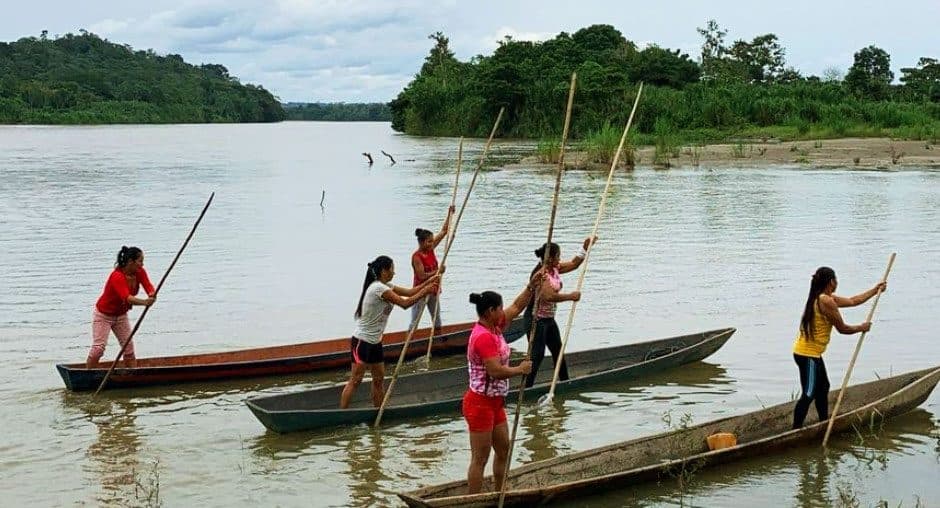
Historical and Geographical Context: The rural parish of Chontapunta, located in the eastern part of the Tena canton, Napo province, is a vast territory where virgin rainforest still dominates 63% of the landscape. It was officially created on April 30, 1969, although its current configuration is the result of the resilience of its inhabitants. In 1970, a devastating flood of the Napo River swept away the original settlement, forcing the Political Lieutenant Fabiani Paredes and the first settlers—such as Amador Mantilla and Raúl Jiménez—to seek safer land for the parish seat. The name "San José" was suggested by the missionary priest Ottorino Todescatto, solidifying the identity of this Amazonian corner that borders the provinces of Orellana and Pastaza. Geographically, it is a strategic biodiversity hotspot with a tropical rainforest climate and Inceptisol soils, ideal for wildlife and traditional agriculture.
Cosmovision and Legends:
For the inhabitants of Chontapunta, the rainforest is inhabited by spiritual beings known as "Amu," forces that maintain the natural balance and whose permission must be sought before taking any resource from the forest. Among their most fascinating stories is the legend of Rayu Rumi (the Thunder Stone); it is said that ancient shamans tried to control Rayu, a being of light, to guide them during their nights of fishing. Feeling betrayed and thrown into an abyss under the influence of ayahuasca, Rayu transformed into the fractured rocks that characterize certain stretches of the Napo River today. Also enduring is the myth of Indi (the Sun) and Quilla (the Moon), who exchange their paths to balance the heat and humidity of the earth, and the story of the Great Tree of Life, whose falling leaves gave rise to all the birds, animals and fish of the Amazon.
Cultural Identity and Flavors
The identity of Chonta Punta is an ethnic mosaic where the Kichwa, Waorani, and mestizo settlers coexist, with a strong indigenous presence representing more than 85% of the population. The cornerstone of their social life is the Chakra system, an agroforestry production unit where cacao—which occupies more than 4,000 hectares in the parish—coexists with medicinal and food plants. The day begins at dawn with the Wayusa Upina ceremony, where dreams are interpreted and advice is given while drinking guayusa infusion. In gastronomy, the star dish is Maito, made with tilapia or carachama wrapped in bijao leaves, accompanied by nutritious chontacuros (palm grubs) and the traditional chicha de chonta, especially during the Uwi festival in April, a ritual of gratitude for the harvest.
Tourism Potential and its Star Attraction
Chonta Punta's tourism potential lies in its deep rainforest and immersive experiences. The star attraction is undoubtedly the Cascada de los Loros (Parrot Waterfall), a crystalline waterfall surrounded by petrified lava formations from the Sumaco volcano, where a wide variety of butterflies and birds can be observed. For those seeking community-based tourism, the Runashitu (Humu) project offers lodging in traditional cabins, birdwatching, and canoe trips, allowing for a genuine connection with the Kichwa culture. Other points of interest include the prestigious Yacuma Ecolodge, a model of sustainability that utilizes solar energy, and the Loreto Water Park, ideal for family recreation, located just a few kilometers from the parish seat.